
/ Investors
Potash 101: The Foundation of Global Food Security
Few commodities are as fundamentally important to the future of humanity as potash. While it rarely makes headlines, potash is one of the world's most strategic natural resources, underpinning modern agriculture and helping feed a growing global population.
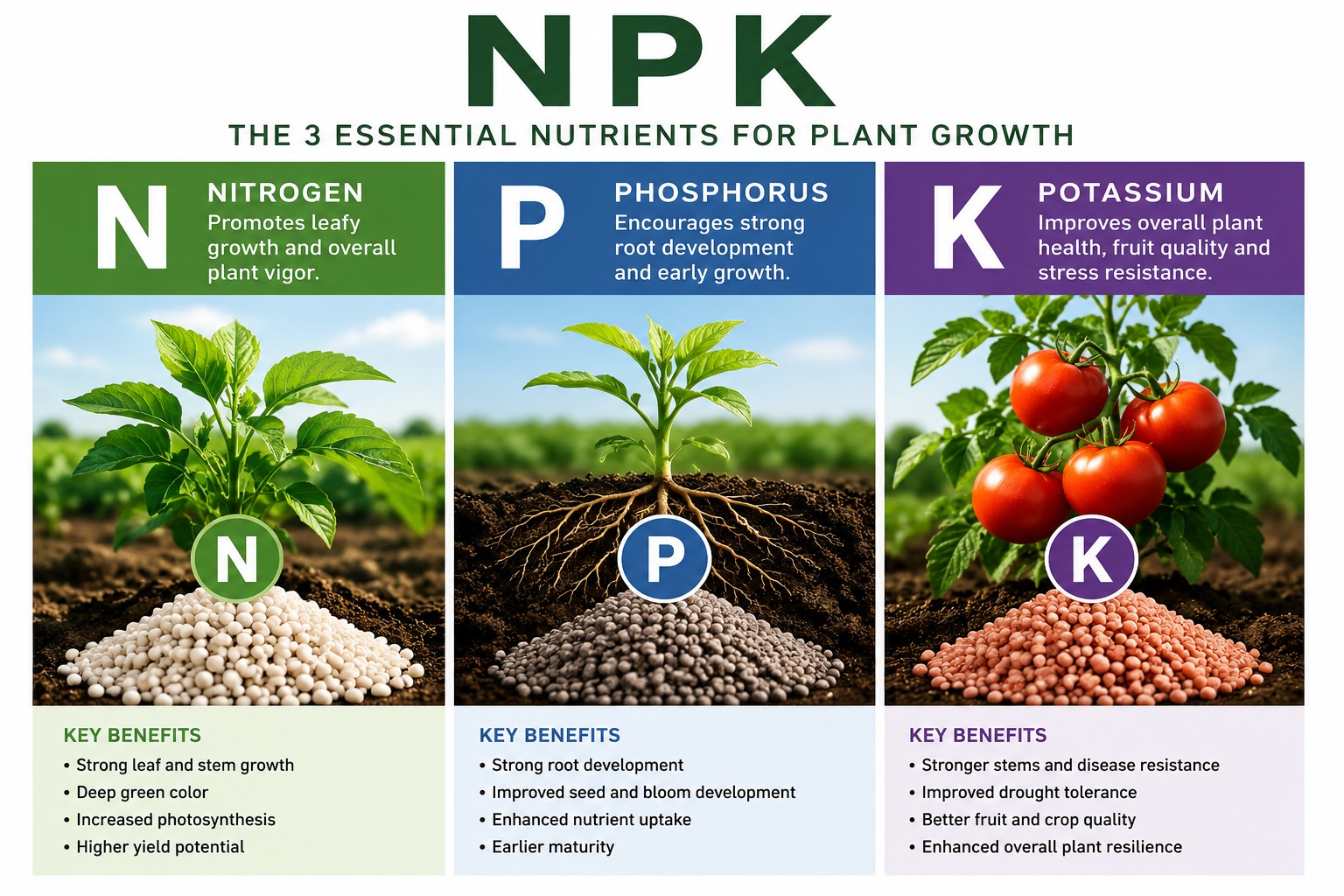
Potash is the primary source of potassium, one of the three essential nutrients required for healthy plant growth alongside nitrogen and phosphorus. Every harvest removes potassium from the soil, and without replenishment, crop yields decline, food quality deteriorates, and agricultural productivity suffers. There is no substitute for potassium in plant nutrition.
This creates a powerful long-term investment thesis. Global population growth, changing dietary habits, limited arable land, and the increasing need to produce more food with fewer resources continue to drive demand for crop nutrients. As farmers strive to maximize yields and improve efficiency, potash remains an indispensable input in the global food supply chain.
The world's largest potash deposits were formed hundreds of millions of years ago through the evaporation of ancient inland seas, creating vast reserves of potassium-rich minerals deep beneath the Earth's surface.
Canada—and particularly Saskatchewan—occupies a unique position in this landscape. Home to some of the highest-grade and largest potash reserves on Earth, the province has become the cornerstone of global potash production. Its stable political environment, world-class infrastructure, and proven mining expertise make Saskatchewan one of the most attractive jurisdictions for long-term investment in critical minerals.
The industry itself is evolving. While conventional underground mining has historically dominated production, advances in solution mining and modular processing technologies are transforming how new projects are developed. These innovations have the potential to reduce capital requirements, improve operating efficiency, accelerate project timelines, and lower environmental impacts—making the next generation of potash projects increasingly attractive to investors.
For investors, potash represents more than a commodity. It is an investment in one of the world's most resilient and essential industries. Regardless of economic cycles, global agriculture must continue to produce more food for more people. As governments prioritize food security and nations seek reliable fertilizer supplies, high-quality potash assets are positioned to play an increasingly strategic role.
The future of agriculture depends on productivity. Productivity depends on plant nutrition. And plant nutrition depends on potash. It is a simple equation that underscores why potash remains one of the most compelling long-term opportunities in the global resource sector.
Potash Mining- 2 Main Methods
Conventional Underground Mining
Involves sinking shafts, and using people, equipment, and materials underground to access and remove raw potash ore (sylvinite) and hoist it to surface for processing
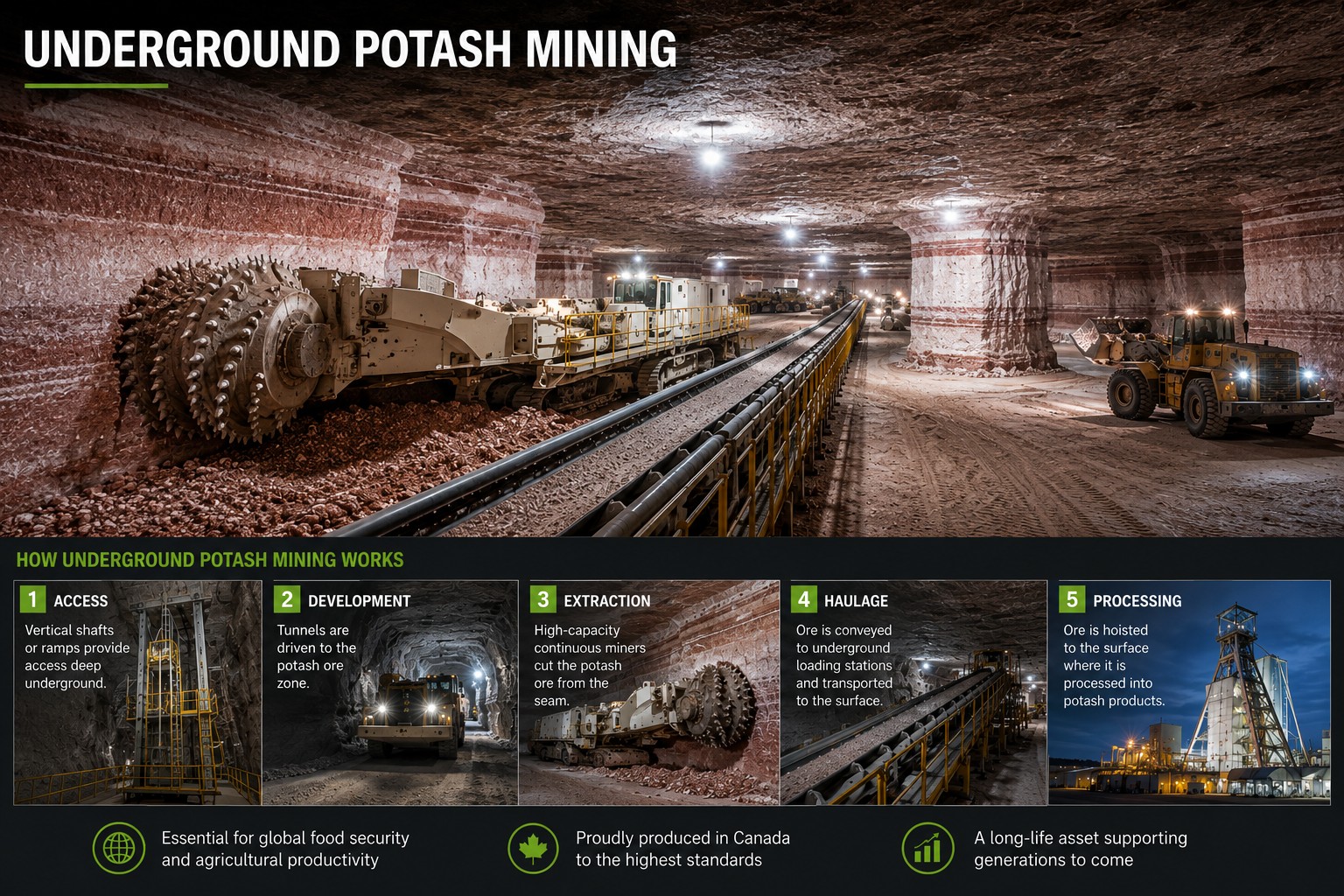
Conventional underground mining is very capital intensive and requires millions of production tonnes to be economically viable. Creates massive salt tailings piles as part of the processing operation.
Conventional Solution Mining
Involves pumping fresh water into the underground ore body, where it dissolves both the halite and sylvite from the sylvinite ore body. The resulting brine is then pumped back to surface to extract the potash.
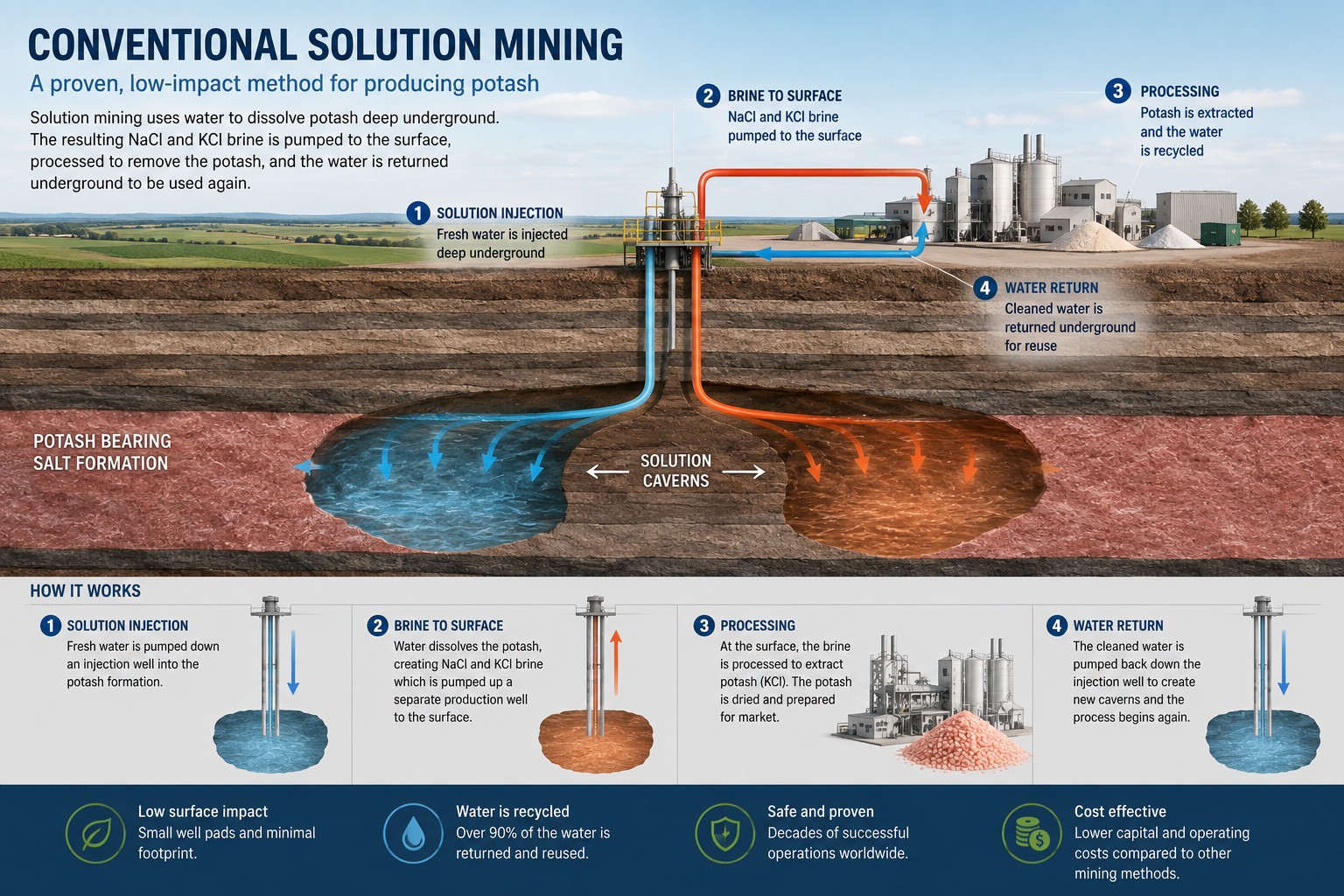
Conventional solution mining tends to be less capital intensive but still requires millions of tonnes of production to be economically viable. Creates massive salt tailing piles as part of the processing operation.
Selective Solution Mining – A Form of Solution Mining
Selective solution mining is an advanced form of solution mining that is designed to dissolve potassium chloride (KCl) while leaving most of the sodium chloride (NaCl) behind. Unlike conventional solution mining, which dissolves both salts and requires extensive surface processing to separate them, selective solution mining aims to recover a much higher-grade potash brine directly from the underground deposit.
The process begins by drilling a pair of wells into the potash-bearing formation. A specially formulated heated brine—already saturated with sodium chloride—is injected into the ore body. Because the brine is already saturated with NaCl, it has very little capacity to dissolve additional salt. Instead, it preferentially dissolves the potassium chloride, producing a potassium-rich brine that is pumped back to the surface through a production well.
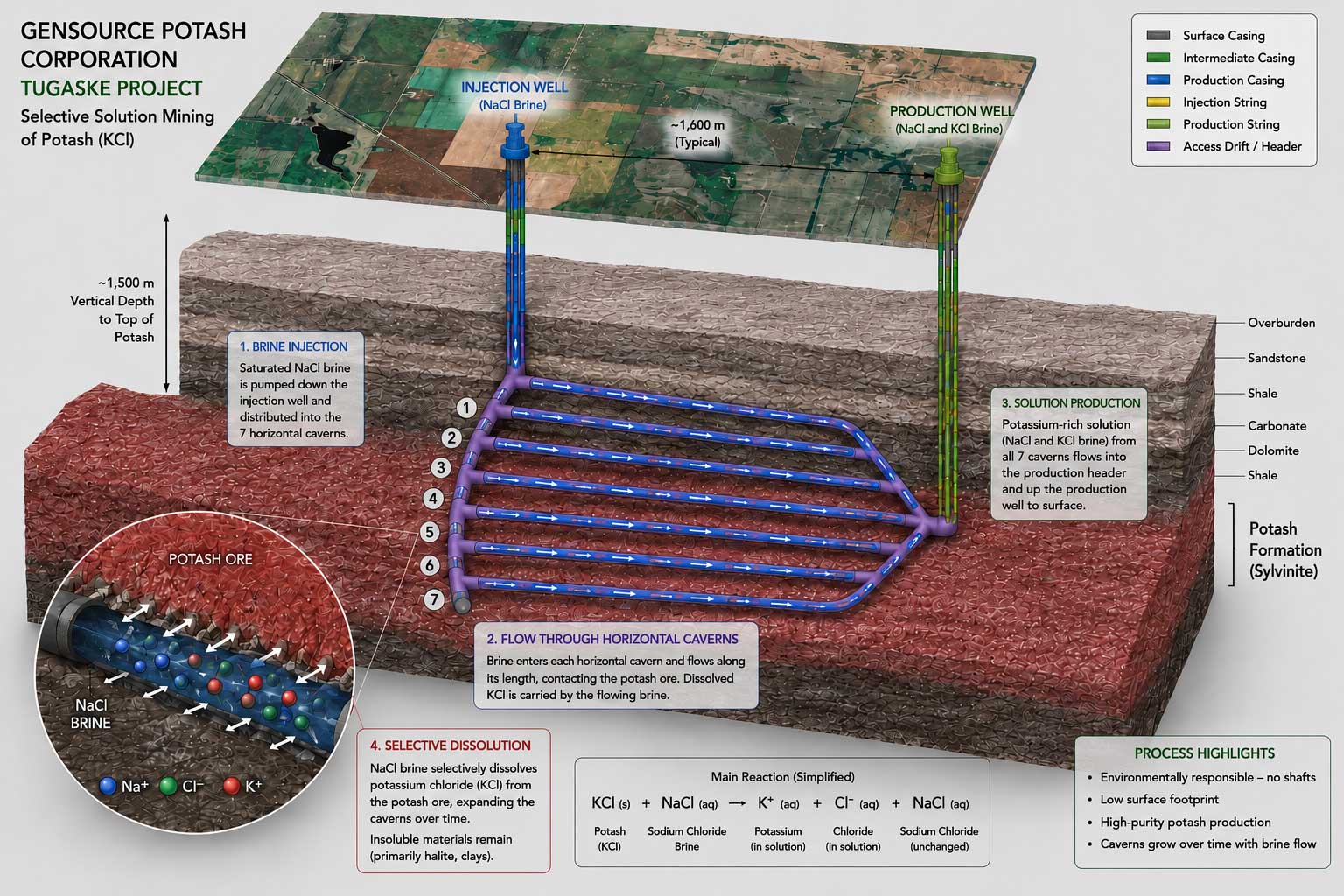
Selective solution mining represents the next evolution in potash production. By recovering only the valuable mineral rather than dissolving the entire salt seam, operators can improve efficiency while reducing environmental impacts. The technology is particularly well suited to deep potash deposits that are uneconomic to mine conventionally and aligns with the mining industry's increasing focus on sustainability (no salt tailings pile), capital efficiency (less capital cost and scalable), and responsible resource development.